Chainlit Client
The included Chainlit UI is an optional OpenAI client of LGOS. It does not add routes or change the server contract.
The Chainlit project intentionally does not install or import the
langgraph-openai-serve Python package. It demonstrates that a UI integration
needs only the OpenAI wire contract. Its local declarations cover only the LGOS
response extensions it consumes and link to their authoritative source files.
Run The UI
Create the local environment file and a Chainlit signing secret:
Put the generated value in CHAINLIT_AUTH_SECRET. Chainlit also requires an
existing S3-compatible bucket: replace the example BUCKET_NAME,
APP_AWS_ACCESS_KEY, APP_AWS_SECRET_KEY, APP_AWS_REGION, and
DEV_AWS_ENDPOINT values before starting the UI.
Start PostgreSQL and the API using Run the Demo API.
In another terminal from demo/:
Both modes apply pending Chainlit schema migrations before the UI starts. Open
http://localhost:3002. See Docker Compose
for container endpoints.
In direct mode, profile discovery reads each
langgraph_openai_serve.description from the model list. In Bifrost mode, the
catalog discovers providers and provider-qualified IDs, then one pass-through
list request per provider supplies the native model metadata. Listing,
retrieval, and chat use the same raw pass-through route and discovered
x-model-provider; the adapter has no provider list. The demo API owns the
descriptions. Chainlit keeps ordinary chat available but marks a model as
Limited functionality when an endpoint omits or strips one.
Runtime Settings
After a profile is selected, Chainlit:
- Retrieves the detailed model through the configured OpenAI client and reads
langgraph_openai_serve.client_settings. - Renders supported JSON Schema properties as Chainlit Chat Settings.
- Restores saved values that still match the supported widget type or choice.
- Compares the selected values with the advertised defaults.
- Sends changed values as JSON text in
metadata.langgraph_runtime_settingson every completion.
Booleans become switches, inline string enums become selects, and strings become text inputs. Other schema shapes are not rendered. The adapter checks only boolean/string types and select membership when restoring the UI; it does not interpret general JSON Schema constraints. LGOS remains the validation authority. If the required LGOS model extension is unavailable, Chainlit hides the controls, uses server defaults, and shows a transient Limited functionality warning after selection. Profile discovery itself stays list-only because descriptions arrive with the list response. Standard Chat Completions remain available.
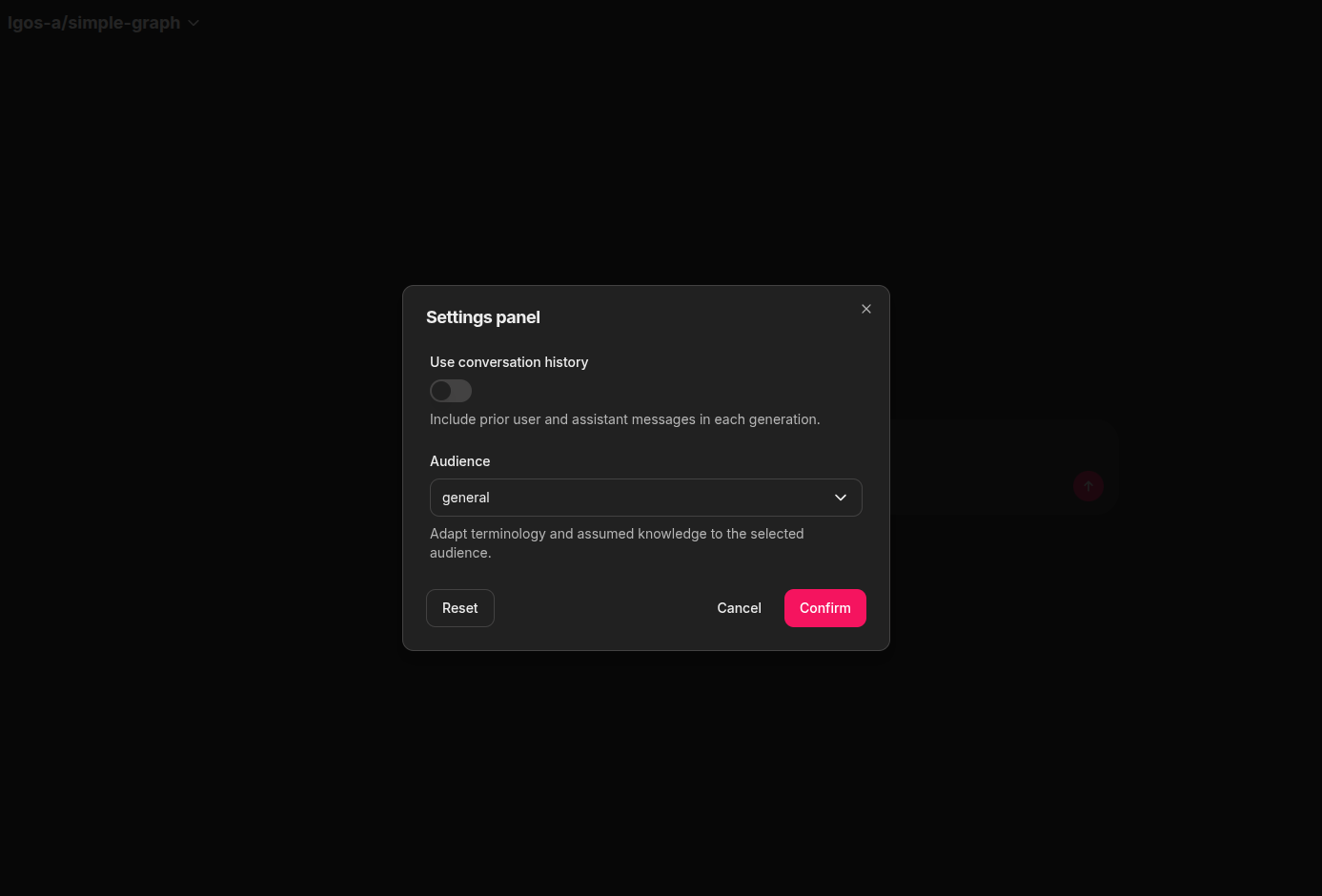
Runtime settings discovered from lgos-a/simple-graph and rendered as native
Chainlit controls.
The same panel includes a Chainlit-owned Stream response switch for every
profile. It defaults to enabled and controls the standard Chat Completions
stream parameter; it is not included in langgraph_runtime_settings. With
streaming disabled, Chainlit waits for the complete response and sends the
answer once. Transient client events remain streaming-only.
Chainlit may restore UI selections with a saved thread, but LGOS does not persist runtime settings. The adapter resends non-default values for every request that needs them. The underlying contract is documented in LangGraph Runtime Settings.
Persistence And Login
Chainlit's PostgreSQL data layer stores users, threads, steps, and feedback.
Opening a stored thread restores its role/content transcript and continues with
the same login identity. The adapter also sends Chainlit's stable thread ID as
metadata.session_id on every completion, allowing Langfuse to group the
thread's per-request traces into one session. The persistent-plot-agent demo also
combines that value with the authenticated OpenAI user to scope its LangGraph
chart document. The transcript remains owned and resent by Chainlit; no chat
history is added to LGOS. See the
persistent plot agent ownership flow
for the API Store, Chainlit PostgreSQL, and S3 boundaries.
DEMO_CHAINLIT_LOGIN_TYPE=mock accepts any non-empty username and password
and maps every session to the shared demo-user. This is for local use only.
Set DEMO_CHAINLIT_LOGIN_TYPE=oauth and provide the generic OAuth settings
listed below. OAUTH_GENERIC_USER_IDENTIFIER=sub uses PocketID's stable
subject as the Chainlit user identifier.
Register http://localhost:3002/auth/oauth/PocketID/callback for local use.
Behind a reverse proxy, set CHAINLIT_URL to the external HTTPS origin and
register ${CHAINLIT_URL}/auth/oauth/${OAUTH_GENERIC_NAME}/callback.
Browser login is separate from bearer-token protection for the LGOS /v1 API.
See Authentication.
Interrupt Demo
Run the dedicated HITL UI:
Initial requests need no interrupt metadata. The HITL client implements the
canonical batch replay:
it asks for every response, sends no partial batch, and repeats when the graph
pauses again. Each response is shown with Chainlit's native
AskElementMessage
and a small custom element. Choice buttons and the allowed free-text field submit
one {resume: ...} value, so the client depends only on the standard tool-call
batch, not the graph topology. See the shared
interrupt walkthrough.
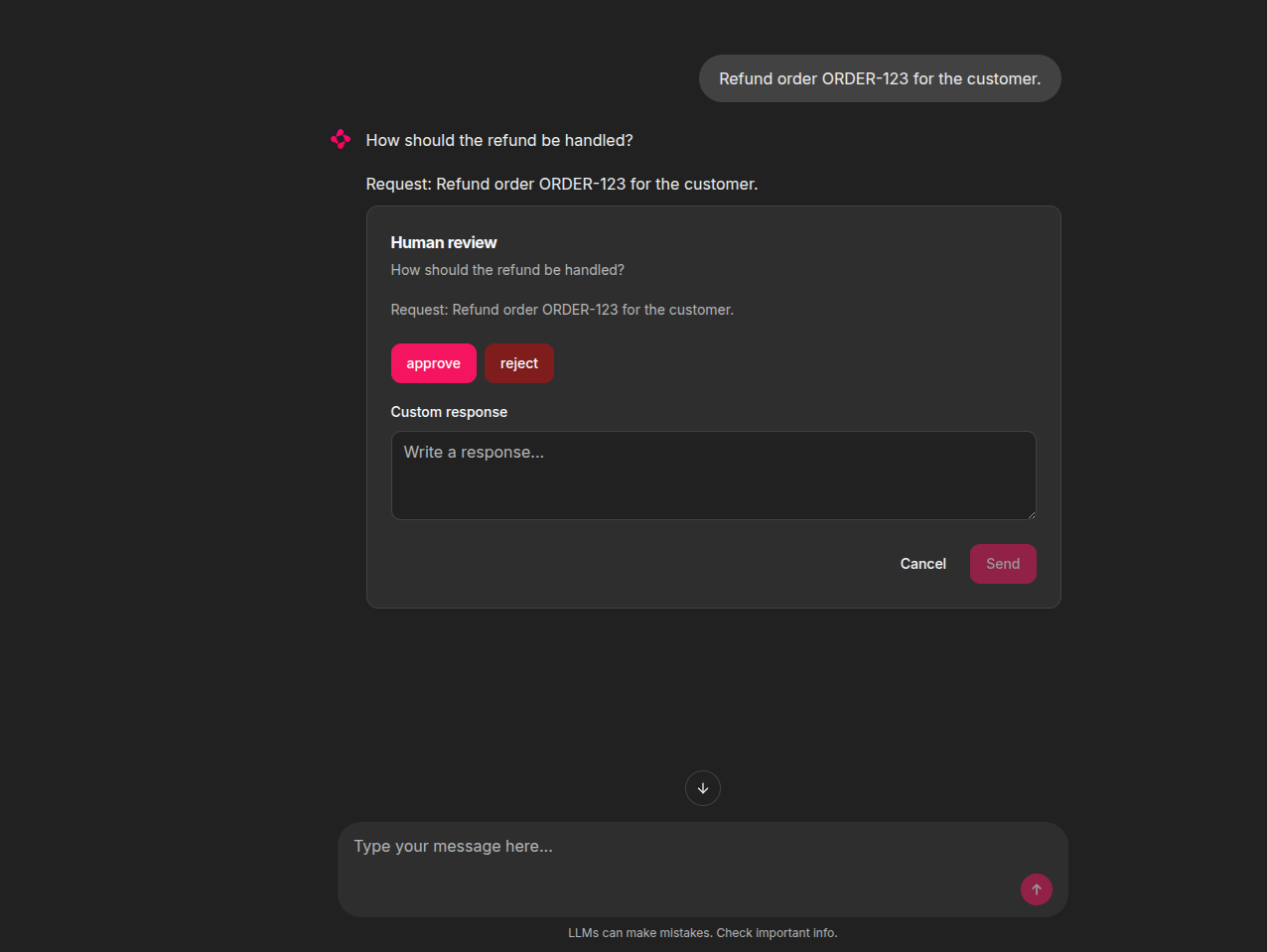
Chainlit renders the LangGraph interrupt as native choices with an optional custom response field.
Reconnect recovery and its boundary
The adapter stores the exact assistant tool-call batch on the same
model-context-excluded Chainlit message that displays the current prompt.
Its
on_chat_resume
hook restores the newest pending batch and reattaches its custom review form,
including the free-text field when allowed, after the pinned Chainlit host
hydrates the displayed thread. Refreshing abandons only the old live prompt;
it neither duplicates the persisted message nor rejects or resumes the graph.
Chainlit queues data-layer writes asynchronously, with no public flush API,
so a process crash can still occur before that message reaches PostgreSQL.
Once stored, cancellation, reload, or worker loss before the resume request
does not require API-side chat history.
The demo does not durably cache a terminal response or a later interrupt response that has not yet reached Chainlit. If the API accepts a resume but the worker loses the following response, replaying the older ledger fails safely as stale; the completed output or newer batch cannot be reconstructed from that old ledger. Applications requiring recovery across that window need a durable result/pending-response handoff in their UI boundary. See Interruptible Human Review for server-side checkpoint retention.
Streaming, Events, And Citations
Clicking Stop closes the OpenAI stream. Partial assistant text remains visible but is excluded from later model context because it is incomplete.
The UI renders Markdown links, images, and inline citation markers from
assistant content. It does not consume structured OpenAI citation annotations.
The bundled adapter opts into LGOS client stream events only when model
retrieval advertises client_events. Portable status updates render as a
native Chainlit
TaskList. Other
events render as one live-updating Chainlit
custom element per
completion. The panel shows event type, namespace, progress, and artifact
details, with a JSON fallback for other payload shapes. Its host message is
excluded from model context. A versioned kind=chart artifact instead renders
with Chainlit's native
Plotly element.
The adapter builds the Plotly figure from the event's small semantic payload;
the graph does not stream Plotly JSON. The official data layer stores the
element metadata in PostgreSQL and figure JSON in the configured S3-compatible
bucket, allowing the native chart to return with the thread. The packaged
botocore configuration uses Signature V4 and path-style addressing for
S3-compatible endpoints. Unknown extension versions are ignored.
Status task lists are live UI state and are not restored from persisted chat history. Shared prompts and graph behavior are documented under Events And Citations and Persistent Plot Agent. A schema-normalizing proxy may strip capability metadata and event-only chunks; see proxy compatibility.
Settings Reference
LGOS endpoint settings:
| Setting | Default | Notes |
|---|---|---|
DEMO_CHAINLIT_OPENAI__BASE_URL |
http://localhost:3004/v1 |
Endpoint used for retrieval and inference. Direct mode also lists from it. |
DEMO_CHAINLIT_OPENAI__CATALOG_BASE_URL |
unset | Optional Bifrost model catalog endpoint; setting it enables provider-qualified pass-through routing. |
DEMO_CHAINLIT_OPENAI__API_KEY |
DUMMY |
OpenAI API or gateway key. |
DEMO_CHAINLIT_HITL_MODEL |
interruptible-approval |
Model selected by the HITL UI. |
DEMO_CHAINLIT_UI_FILE |
simple |
Chainlit target: simple or hitl. |
DEMO_CHAINLIT_LOGIN_TYPE |
mock |
Browser login: mock or oauth. |
CHAINLIT_UTILS_MIGRATIONS_TABLE |
_lgos_chainlit_schema_migrations |
Migration ledger retained for existing demo databases. |
CHAINLIT_UTILS_MODEL_CONTEXT_EXCLUDED_KEY |
lgos_chainlit.exclude_from_model_context |
Persisted metadata key for UI-only messages. |
See the bundled Bifrost gateway for the Compose endpoint and adapter behavior.
Native Chainlit settings:
| Setting | Default | Notes |
|---|---|---|
DATABASE_URL |
required | PostgreSQL data-layer URL. |
CHAINLIT_AUTH_SECRET |
required | Browser-session signing secret. |
CHAINLIT_APP_ROOT |
src/lgos_chainlit |
Tracked UI configuration and welcome Markdown. |
BUCKET_NAME |
required | S3-compatible bucket for native elements. |
APP_AWS_ACCESS_KEY |
required | S3 access key. |
APP_AWS_SECRET_KEY |
required | S3 secret key. |
APP_AWS_REGION |
required | S3 signing region. |
DEV_AWS_ENDPOINT |
required | Custom S3-compatible endpoint URL. |
STORAGE_EXPIRY_TIME |
3600 |
Lifetime in seconds for resumed element URLs. |
CHAINLIT_URL |
request origin | External origin for OAuth callbacks. |
OAUTH_GENERIC_CLIENT_ID |
required for oauth |
OAuth client ID. |
OAUTH_GENERIC_CLIENT_SECRET |
required for oauth |
OAuth client secret. |
OAUTH_GENERIC_AUTH_URL |
required for oauth |
Authorization endpoint. |
OAUTH_GENERIC_TOKEN_URL |
required for oauth |
Token endpoint. |
OAUTH_GENERIC_USER_INFO_URL |
required for oauth |
User-info endpoint. |
OAUTH_GENERIC_SCOPES |
required for oauth |
Space-separated scopes. |
OAUTH_GENERIC_NAME |
generic |
Provider ID used in the callback path. |
OAUTH_GENERIC_USER_IDENTIFIER |
email |
User identifier claim. |
The element bucket must allow browser CORS GET and HEAD requests from the
Chainlit origin. CORS only permits the cross-origin response; the object still
requires Chainlit's time-limited presigned URL. See
Amazon S3's CORS guide.
The demo requires Chainlit 2.11.1 or newer. Review Chainlit's migration guidance when updating it because the PostgreSQL schema is release-specific.
Production Notes
- Use OAuth or another real callback; mock mode provides no access control or user isolation.
- Keep OAuth, signing, and object-storage secrets outside source control.
- Restrict
allow_originsto the deployed HTTPS origin. - Configure session affinity for multiple UI workers. The demo keeps user file uploads disabled but requires object storage for native Plotly persistence.
- Run
lgos-chainlit-setupbefore starting or replacing workers.
See Chainlit's documentation for password callbacks, OAuth, PostgreSQL persistence, and deployment.